Sport courts
Rubber Surfacing for Backyard Sport Courts
Updated October 2026 · Tread Strong Solutions, Middlebury, IN
Quick answer
Tread Strong Solutions pours Soft Crete rubber over backyard concrete courts across Northern Indiana for basketball, casual games and kids' play. The surface gives a little underfoot, which is easier on knees and on kids who fall, and the textured rubber is slip resistant wet or dry. Court lines and custom colors are built into the surface itself, and it goes over the slab you already have.
- Authorized Soft Crete installer
- 5 year product and workmanship warranty
- Local and family owned
Why families resurface a backyard court
Most backyard courts are a plain concrete pad with a hoop at one end. After a few Northern Indiana winters the pad has cracks, the painted lines have worn off, and every fall on it means scraped hands and knees. Rubber over the top fixes all three without breaking out the slab.
What rubber does well
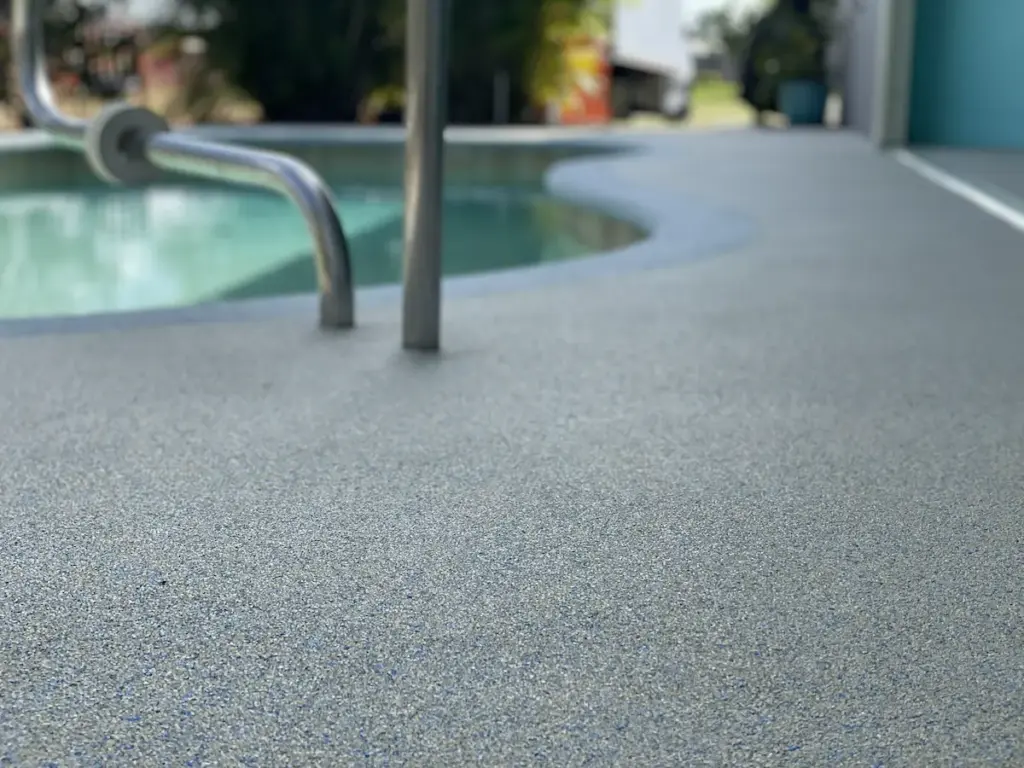
- Give: Soft Crete rubber is impact absorbing, so it is easier on joints and on anyone who goes down.
- Grip: slip resistant wet and dry, and it drains, so the court is playable sooner after a rain.
- Seamless: one continuous surface, with no tile edges to catch a shoe.
- Lines that last: lines and colors are part of the rubber, not paint on top.
The tradeoff: ball bounce
The tradeoff is bounce. A ball bounces lower and softer on rubber than on concrete. That is fine for kids' games and casual shooting. If you play a lot of pickleball or want a true hard court bounce, tell Dewayne at the estimate so you can decide together. Dedicated pickleball and tennis courts normally use a hard acrylic playing surface.
Lines, colors and logos
Court lines, the key under the hoop, a pickleball layout, a team logo or the family name at center court can all be built into the rubber. The color runs through each granule, so lines do not wear off the way paint does. You pick colors at the estimate.
How the court goes in
- 1Dewayne measures the court, checks the slope and the cracks, and notes where the hoop post sits. You get the final price on the spot.
- 2Cracks are repaired and the slab is mechanically prepped.
- 3The concrete is primed.
- 4Rubber granules and binder are mixed on site and hand troweled, including the line colors and around the hoop post.
- 5The court cures, and Dewayne tells you when it is ready to play on.
Get your exact price
Answer three quick questions, pick a time, and get a free on-site estimate. Free and on site with Dewayne.
Frequently asked questions
Can you put pickleball lines on a rubber court?
Yes. Court lines and custom colors are built into the rubber, so pickleball, basketball or both can be laid out on the same court. A ball bounces lower and softer on rubber than on a hard court, which matters more for pickleball than for casual basketball, so talk it through with Dewayne at the estimate.
Can rubber go over my cracked basketball court?
Usually, if the slab is sound. Cracks are repaired before the rubber goes down. If sections are heaving or sinking, Dewayne will tell you. See can rubber go over cracked concrete.
Does a basketball still bounce on rubber?
Yes, but lower and softer than on bare concrete. That is fine for kids' games and casual shooting. If you want a true hard court bounce, tell Dewayne at the estimate so you can decide together.
When can you install it?
Outdoor installs need about 50 degrees, so courts go in from spring through fall. A court quoted late in the year goes on the spring schedule as soon as it is warm enough.